Tour Overview
Highlights

Itinerary A
5 Days / 4 Nights
Friday - Tuesday
Visiting Santiago Islands, Bartholomew, North Seymour, San Cristobal Island.
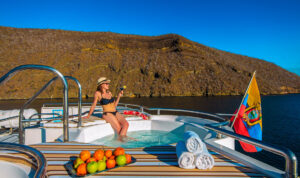
Arrive on the Galapagos Islands at Baltra Airport and be met by a guide, who will collect your luggage and escort you on a short bus ride to the harbour to board the Catamaran Treasure.
In the afternoon, your first excursion will commence, disembarking at the Itabaca Channel for a drive through the highlands of Santa Cruz Island, a region populated by Galapagos giant tortoises. After spending your afternoon with these walking dinosaurs, you will board for dinner, entertainment and relaxation.
In the morning, enjoy an excursion to Sullivan Bay on Santiago Island. This bay, at first glance, looks like a moon landing, with rocky shores and empty fields. However, this area is extremely popular among photographers, due to the diverse fauna, where you can spot green sea turtles burrowing in the white sand beach, where you can also spot crabs, blue herons, and oystercatchers.
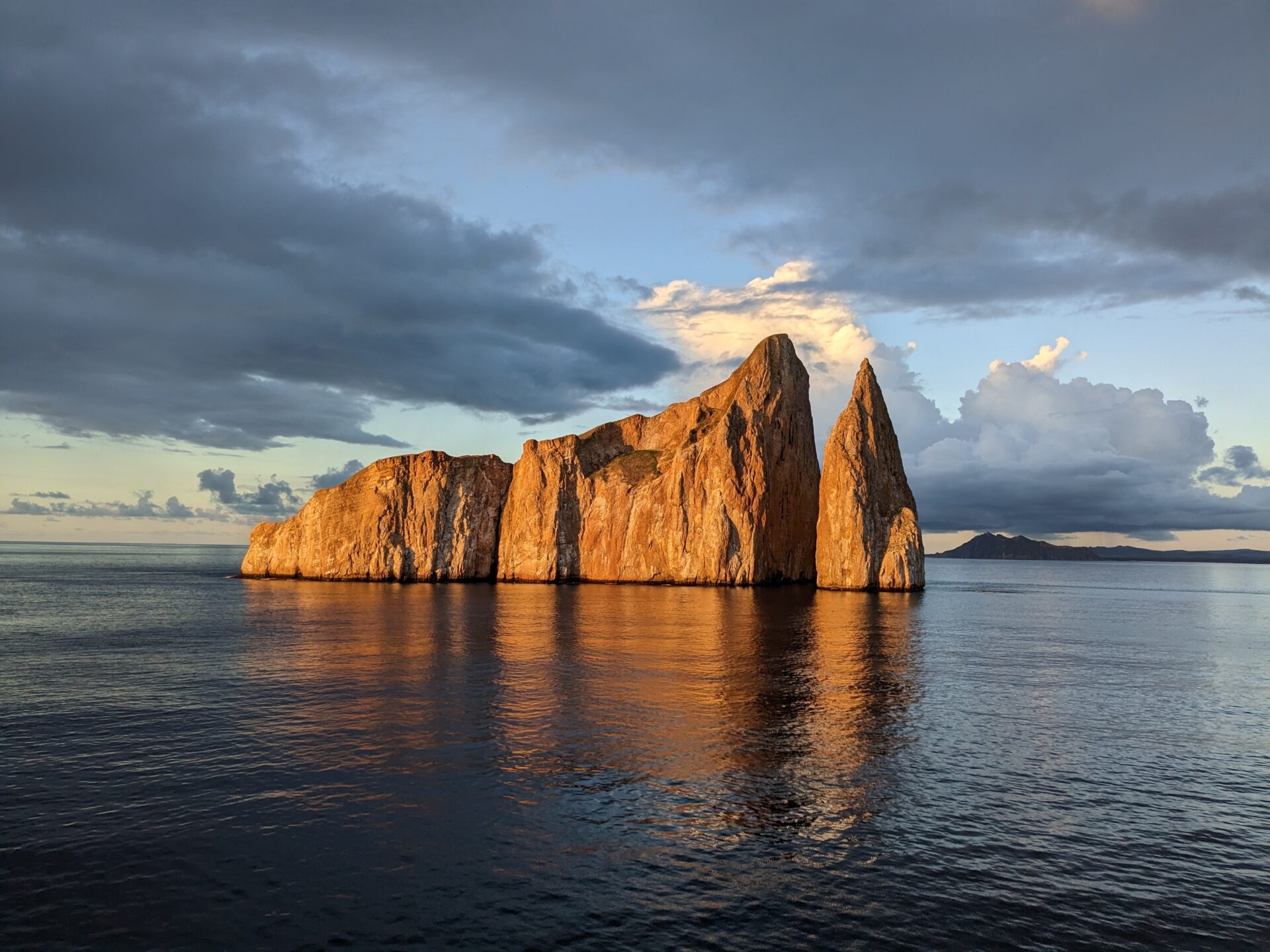
Continue in the afternoon to Bartholomew Island. Here, you can climb the Bartolome peak trail to see the stunning panoramic views over volcanic peaks, lunar craters, and lava fields. Afterwards, you can enjoy a snorkelling adventure of the famous “Pinnacle Rock”. At Bartholomew, you might spot a nearby colony of Galapagos penguins, as well as sea turtles living in the two stunning white-sand beaches.
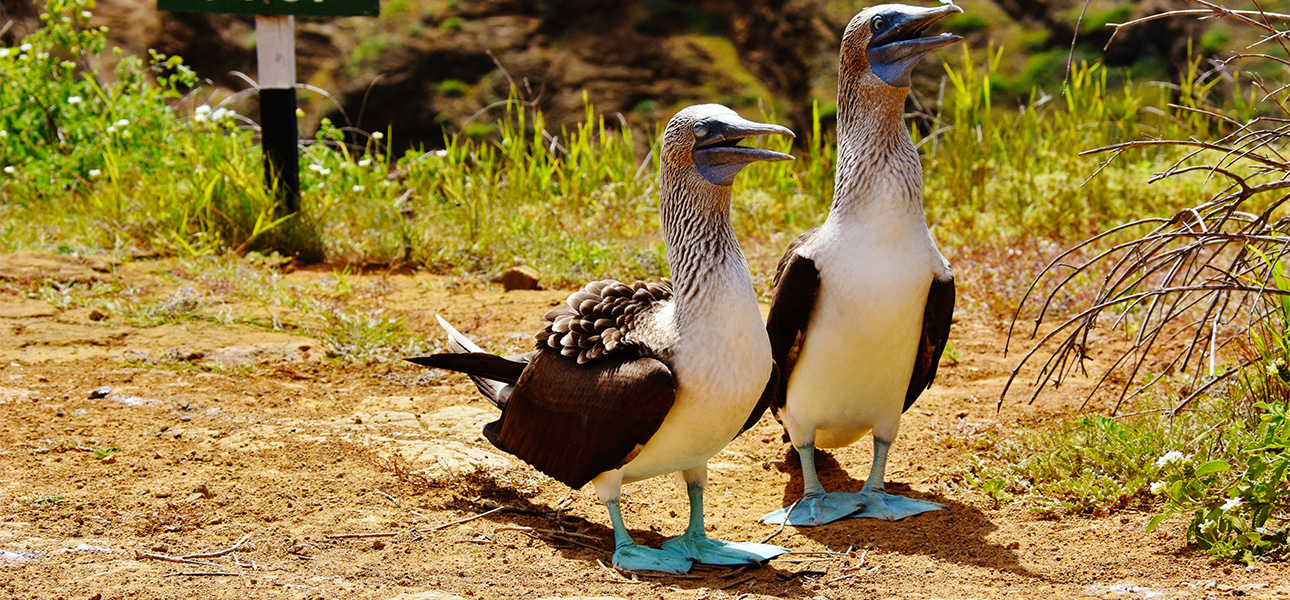
Seymour is a flat, boulder-strewn island, allowing for great nesting sites for native birds. Here, you can spot a large population of magnificent frigate birds and blue-footed boobies. The tremendous waves that pound against the shores of the island allow for you to spot bodysurfing sea lions playing among the surf.
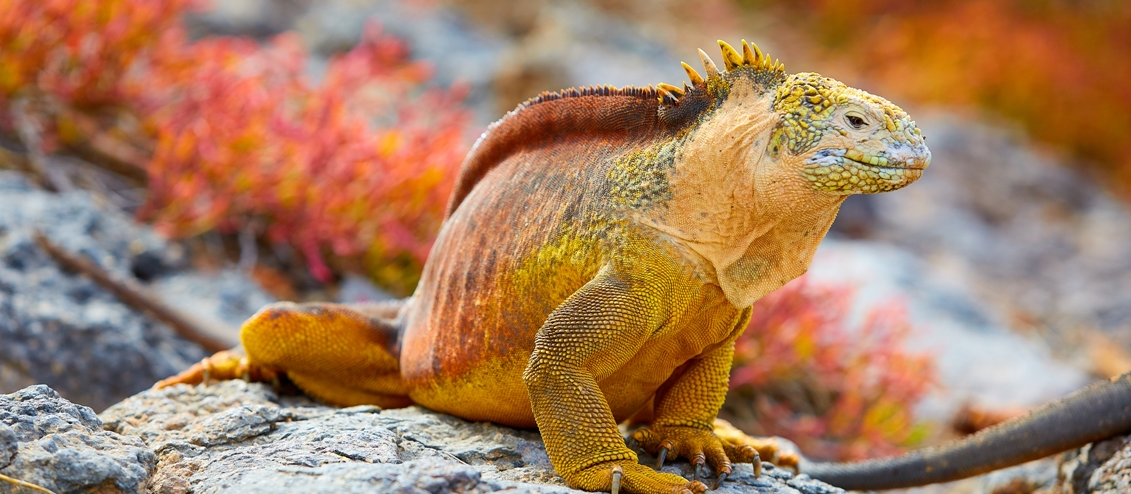
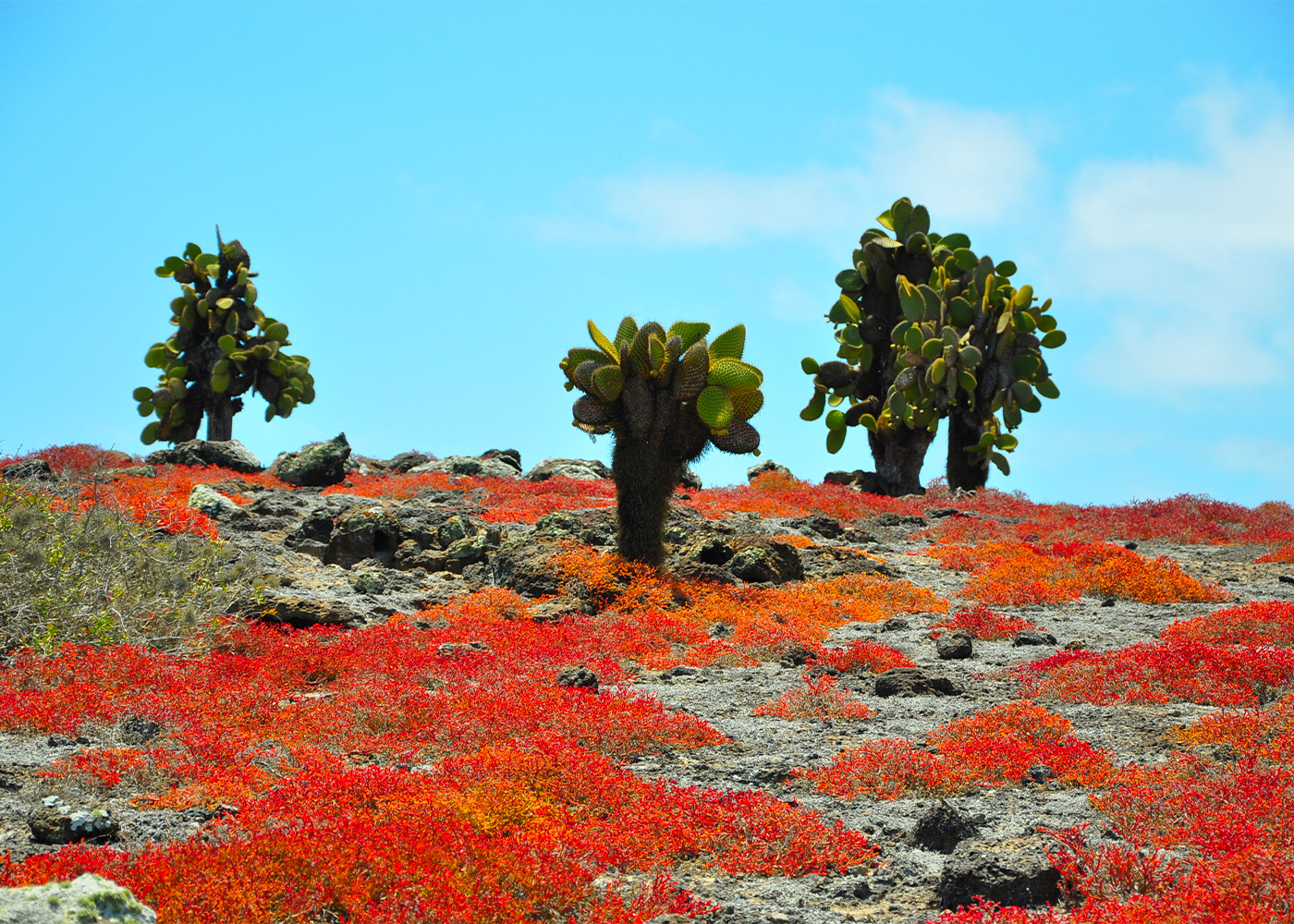
In the afternoon, you will explore the South Plaza Islet. There is a sea lion bull who calls the jetty home, who could delay your landing with his welcoming barking. This islet’s bright red flora and giant Opuntia Cacti that cover the landscape of the island provides food and shelter to thousands of endemic marine and Barrington iguanas. You will also have the opportunity to swim over a reef of boulders that sea turtles, reef sharks, stringrays, and sea lions call home.
Today will take you through two key locations on San Cristobal Island, Pitt Islet and Pitt Point, as well as Witch Hill.
On Pitt Point, you will disembark on the same green sand beach that Charles Darwin first stepped foot on, and be greeted by a group of barking sea lions. Continue onwards to a trail that will take you to the top of the cliff through a ravine, marvelling at the landscape of this geological wonder as you ascend. Along the way, you can spot three species of boobies breeding and playing; blue-footed, red-footed and Nazca boobies. You may also spot Great and Magnificent Frigate Birds. This region also offers a snorkelling and swimming experience.
Continue onto Witch Hill (Cerro Brujo in Spanish), a tranquil bay with a coral sand beach. Snorkelling here shows the rich habitat that marine iguanas, stingrays, white-tipped sharks, eagle rays, turtles, morays, garden reels, and dozens of reef fish, call home. Behind the bay is a dry dark lava flow with sandy ponds that serve as a refreshment point for iguanas, as well as a strategic place to observe coastal and migratory birds including pelicans, blue-footed boobies, and swallow-tailed gulls.
Enjoy a morning visit to the Galapagos National Park Visitor Centre on San Cristobal Island. This Interpretation Centre, lying close to the port town of Puerto Baquerizo Moreno, explains the natural phenomena that formed the islands, as well as the diverse species shaped by the special climate, and remoteness of the archipelago.
Afterwards, transfer to the San Cristobal Airport for departure.
End of Services.
Itinerary B
5 Days / 4 Nights
Tuesday - Saturday
Visiting San Cristobal Islands, Española, Floreana, Santa Fe, Santa Cruz Island, Baltra.
Upon arrival on San Cristobal island, you will be met by a guide, who will receive your luggage and escort you via short bus ride to the harbour.
Afternoon excursion to Colorado Hill, on San Cristobal island. Here you will visit the Colorado Hill Tortoises Protection and Growing Center in the south-east of the island. The center includes a large corral, a Visitors center, breeding center and an interpretative trail. Along this trail is possible to see different species of native and endemic plants as well birds as the San Cristobal Mockingbird, Yellow Warblers, and many species of finches and the Galapagos flycatcher.
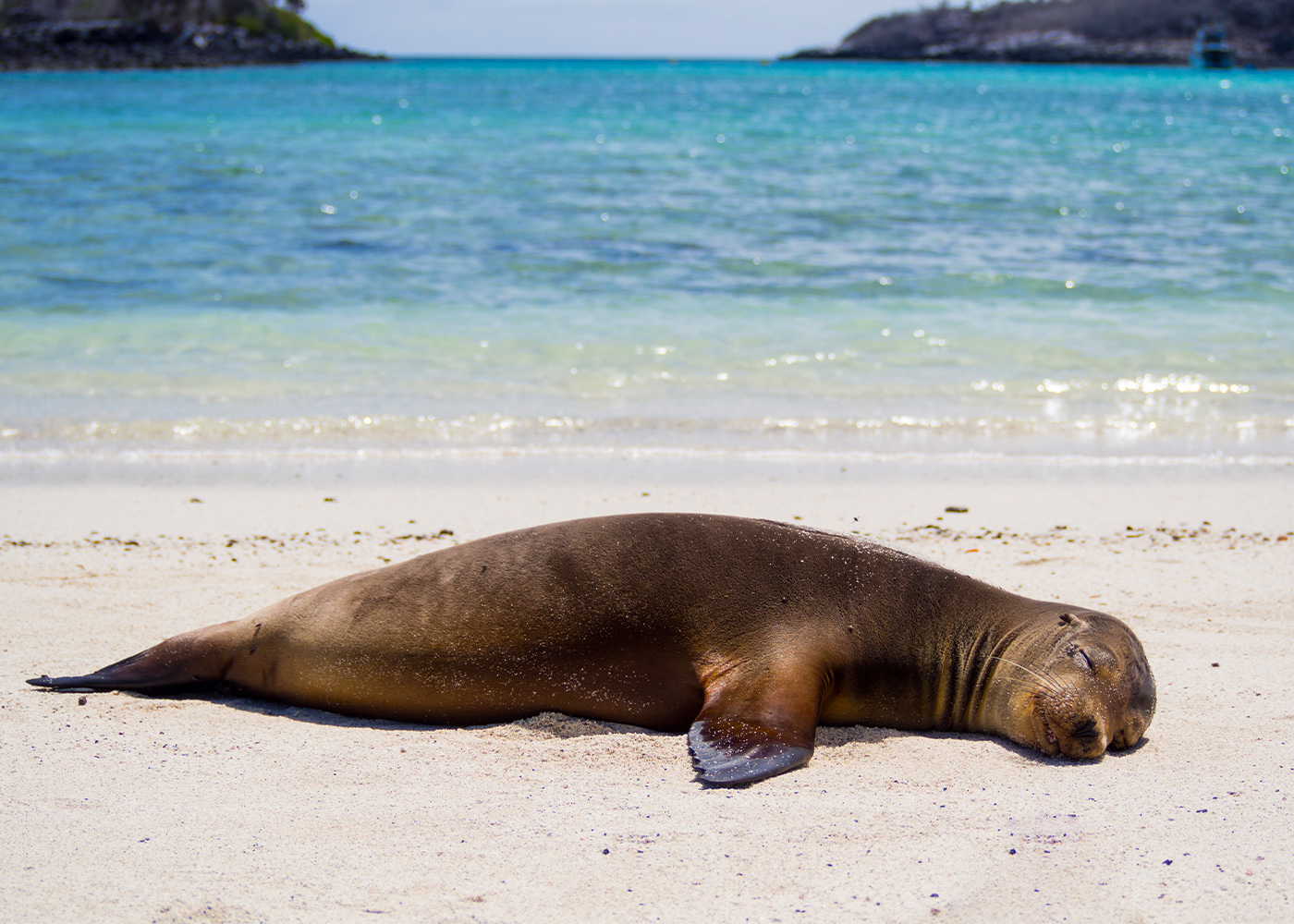
Morning excursion to Gardner Bay on Espanola Island, a wonderful place to cool off in the turquoise water and admire the myriad of colourful reef fish. You will also have the opportunity to snorkel with turtles or enjoy the proximity of playful sea lions. The white-sand beach is also an important breeding ground for green turtles, and its main attraction is the colony of Galapagos sea lions.
In the afternoon, continue to Suarez Point, also on Espanola, is home to some of the most impressive and diverse seabirds in the archipelago. Blue-footed boobies, Nazca boobies, Galapagos gulls, and red-billed tropicbirds are also native to this island. Along the southern coast, huge ocean waves crash against basalt cliffs, forming a spectacular blowhole where water sprays meters high into the air with spectacular views of soaring birds.
Morning excursion to Post Office Bay and Baroness Lookout on Floreana Island. Historically, this sitee is the location of a wooden barrel that was placed in the 18th century by the crew of a whaling ship. The letters found inside the barrel would be picked up and delivered by sailors returning home. There was no postage fee, and, surprisingly, this mailbox and its honor system are still in use today. It is said that Baroness Eloisa von Wagner loved this place and spent several hours watching the horizon. Within walking distance (30 m) are the ruins of what is known as her house. You can also relax on the beach, where you might spot not only Galapagos sea lions, green turtles, and golden rays, but also Galapagos penguins. This is the only place in the southeastern archipelago where penguins reside.
This site offers probably the best Flamingo lagoon in the Galapagos, situated between two tuff lava cones, where you can see various species of shorebirds to observe besides flamingos; the most frequent are common stilts, white-checked pintail ducks and other migratory birds. . It is very interesting to see the two distinct beaches: “The Green Beach” (due to its high percentage of olivine crystals in the sand) and the “Flour Sand Beach” which is made up of coral.
In the morning, excursion to Barrington Bay on Santa Fe island, home to a number of endemic species like the Galapagos Hawk, Galapagos snake, Galapagos mockingbird, rice rats and one of the two species of land Iguanas that call the island home. There is also a notable sea lion colony on the island. Along the trail many salt bushes can be seen as well giant Prickly pear cactus.
Santa Cruz also offers excellent opportunities for viewing wild tortoises, both roaming through pastures in the agricultural zone and in the Tortoise Reserve, which is accessible from Santa Rosa or Salasaca. Several local farms serve food and allow visitors to explore their grounds in search of tortoises. The pond at El Chato is surrounded by forest where short-eared owls, Darwin’s finches, Vermilion Flycatchers, Yellow Warblers, Galapagos Rails, and Paint-billed Crakes can be seen. As the visitor walks into the forests overgrown with lichens, ferns, and other epiphytes, it is time to listen carefully for the sound of heavy footsteps and the sound of shrubs being slowly crushed as the tortoises make their way through the brush.
The Twin Craters are found on either side of the road leading to Puerto Ayora. The craters lie within a lush scalesia cloud forest, a high-altitude plant species that are endemic to the Galapagos. This area is also home to the carpenter finch, which uses tools to search for food. There may also be opportunities to see the vermillion flycatcher, a small red-breasted bird.
Assisted by the naturalist guide and some crewmembers, the dinghy will bring you and your luggage to Baltra Airport, where we will take the shuttle back to the airport.
End of Services
Itinerary C
7 Days / 6 Nights
Saturday - Friday
Visits Santa Cruz Island, Isabela, Fernandina.
Arrive on the Galapagos Islands at Baltra Airport and be met by a guide, who will collect your luggage and escort you on a short bus ride to the harbour to board the Catamaran Treasure.
In the afternoon, your first excursion will commence, disembarking at the Itabaca Channel for a drive through the highlands of Santa Cruz Island, a region populated by Galapagos giant tortoises. After spending your afternoon with these walking dinosaurs, you will board for dinner, entertainment and relaxation.
Today takes you to El Eden, an islet off the western coast of Santa Cruz. On its coast you will observe land iguanas and sea lions soaking up the sun, as well as seabirds feeding in the nearby mangrove forests. It is a perfect location for swimming activities, as the clear and calm waters will allow you to snorkel along tropical fish, rays, and two species of sharks. Alternatively, a kayak ride would be a memorable experience.
In the afternoon, continue to Dragon Hill located in northwestern Santa Cruz Island and consists of a trail that lead to a hyper-saline lagoon behind the beach, frequented by flamingos, pintail ducks and other species of birds. This site has been repopulated with land iguanas from Seymour, Isabela and Santa Cruz islands. There is a short walk to the Hill, which offers a beautiful view of the bay.
Just outside the port of Puerto Villamil on Isabela Island, a group of islets jut out of the ocean. The jagged black formations, dotted with mangroves and candelabra cacti, are the remains of a lava stream that has ended in the ocean. Turtles and graceful eagle rays sometimes glide through this calm channel, as do smaller fish and Galapagos sea lions. After this brief visit, you will continue to the upper part of Isabela.
In the afternoon, continue to the Villamil beach wall hides the Las Diablas lagoon; the largest lagoon in the Galapagos and also the breeding place of the largest concentration of red flamingos. Afterwards, we will follow a trail to the “The Wall of Tears”, due to the harsh conditions prisoners worked in the building of a wall made of lava blocks when the site was used as an Ecuadorian penal colony. You will certainly be able to see quite a bit of wildlife, including many marine iguanas, a wide variety of birds and, as a highlight, perhaps some giant Galapagos tortoises in the wild.
Punta Moreno is located on the north coast of Isabela Island between the volcano Sierra Negra and Cerro Azul volcano. The trail runs along a lava flow Pahohoe into a complex of coastal lagoons, its main attraction are several species of birds which can be found around this lakes and mangroves.
A tour along the cliffs in a zodiac will give the visitors a good chance to see the Galapagos penguin, the flightless cormorant and other sea birds. From the landing dock it is about a 30 minute hike along the trail up to the top of the cliff from where you can view Darwin Lake, an uplifted ultra-saline lake saltier than the sea. You can also see several volcanoes from this location.
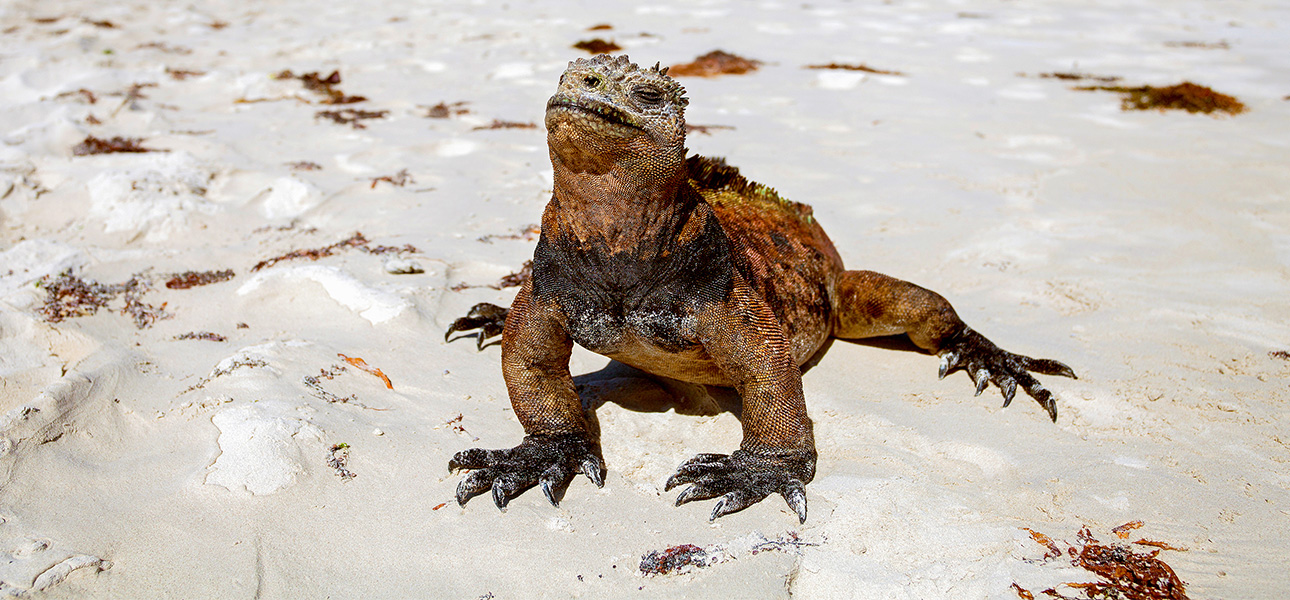
Fernandina is the third largest island in the archipelago and has a single visitor site: Punta Espinoza located at the nor theastern tip of the island. Marine iguanas conglomerate in larger groups than in any other island. They bask around in the sand, swim near the shore and sometime block the way at the landing dock.
Whilst having lunch we will cross the Bolivar Channel for the last time to Vicente Roca Point, just at the mouth of Isabela’s seahorse-shape. The calmer waters of the coves are well-protected against the ocean swell and are a fairly cold, but great place for snorkelling amongst various species of shark, penguins, puffer fish and even seahorses!
Puerto Egas is a black beach is located at the west side of Santiago Island. This site is called Puerto Egas, because there was an attempt of company of Hector Egas, to star t the exploitation of salt, which failed because the price of salt on the continent was very cheap, and did not justify its exploitation in Galapagos.
After a wet landing on the remarkable red beach of Rábida, there are two short guided walks. Iron oxide particles give rocks and sand their reddish color. The beach wall has a shallow lagoon fringed with green; This oasis is the most fertile spot on the otherwise barren islet, which is covered in palo santo trees. The salty lagoon attracts all kinds of waterfowl, including pintails and sometimes red flamingos. Many species of songbirds hide and breed among the evergreen foliage of the surrounding mangroves. One of the most outstanding attractions is the important breeding colony of brown pelicans, the only pelicans in the world that dive.
This morning takes you to Las Bachas beaches on Santa Cruz Island, two small beaches are located to the west of Black Turtle Cove, in Santa Cruz. Its sand consists of decomposed corals, which makes it white and soft. This makes it a favorite nesting site for sea turtles. Behind one of the beaches there are small lagoons, where flamingos and other shore birds, such as Galapagos gulls and lapwings, can be seen from time to time.
Afternoon transfer to Baltra airport for your flight back to Guayaquil or Quito.
Tour Inclusions
- Lodging onboard in private facilities
- Three meals per full-day; unlimited water, coffee and tea
- All excursions as mentioned in the itinerary
- English speaking naturalist guide
- Use of kayaks (if applicable)
- Snorkelling gear
- Airport-yacht-airport transfers (only guaranteed if passengers arrive at the scheduled meeting point, date and time)
Tour Exclusions
- Roundtrip flight to Galapagos Islands from mainland Ecuador
- Galapagos National Park entrance fee (USD 200 pp, subject to change)
- Transit Control Card (USD 20 pp, subject to change)
- Soft and alcoholic drinks
- Wetsuit or other rental equipment
- Gratuities, tips and other items of personal nature
- Travel insurance (mandatory)
Image Gallery